Spring launch is when weak batteries get exposed fast. A battery that limped through last season or sat too long over winter can leave you dead at the dock, chasing voltage problems instead of getting underway.
Choosing the right boat battery is not just about picking the biggest one that fits the tray. You need the right type, the right reserve, and the right setup for how your boat actually starts, charges, and uses power once the season begins.

Spring is also the time to figure out if the existing battery still has life left, if the bank is undersized for the gear onboard, or if the whole system is overdue for an upgrade. If you do need an overhaul, the right choice usually comes down to (1) whether the boat needs starting power, house capacity, or both, (2) whether flooded, AGM, or lithium makes the most sense, and (3) whether the existing charging setup can support it.

Why Your Boat Battery Matters More at Spring Launch

Spring launch is when battery problems stop hiding. A battery that was fine at haul-out can come back weak, undercharged, sulfated, or flat-out done after months of storage, cold weather, and neglect.

That’s why early-season battery checks matter so much: they’re usually the first real test of whether the boat will start cleanly, the electronics will stay online, and the charging system is ready for another season.

The #1 Cause of Launch-Day Failures

A lot of launch-day trouble comes down to one simple problem: a battery that no longer has the juice to do the job. Sometimes that means it cannot crank the engine hard enough to start, and sometimes it means voltage drops low enough to trip out electronics, pumps, or other onboard systems right when they’re needed.

The trouble is that many weak batteries do not look obviously dead until they are put under load. They may show decent voltage at rest, then fall on their face the second the starter turns or the house loads come online.

What Winter Storage Does to Marine Batteries

Winter storage has a way of finishing off batteries that were already on borrowed time. Leave one partially discharged, ignore maintenance charging, or let it sit through months of cold, and you can end up with sulfation, reduced capacity, sluggish charging, less run time, and a battery that folds the minute spring launch puts it to work.

That’s why spring launch is not just about charging the battery and hoping for the best. It’s the right time to inspect condition, test performance, and compare current battery health against how the boat will actually be used this season, especially after a long layup in winter storage.

The 3 Main Types of Marine Batteries Explained

Not all marine batteries do the same job, and a lot of bad battery choices start with treating them like they do. The right setup depends on whether the battery needs to deliver a hard burst of cranking power, support steady house loads over time, or split the difference on a smaller boat with simpler demands. Spring launch is a good time to sort that out, because this is when weak assumptions start showing up as slow starts, drained electronics, and systems that don’t match the boat’s specs.

Comparison Table Overview

Battery Type Best For Main Strength Main Limitation
Starting Engine cranking High burst power Poor choice for repeated deep discharge
Deep Cycle House loads, trolling motors, electronics Better sustained power and cycling Not ideal as a dedicated cranking battery
Dual Purpose Smaller boats with moderate combined needs One-battery simplicity Compromise on both cranking and cycling
Lithium (LiFePO4) Premium house banks, frequent use, electronics-heavy setups Light weight, fast charging, deep usable capacity, long cycle life Higher cost and stricter charging compatibility

Starting Batteries (Cranking Power)

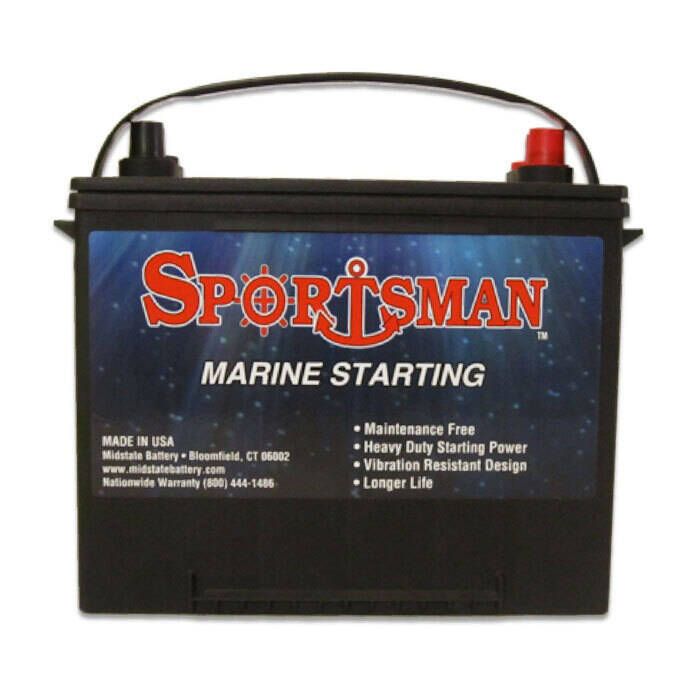
Starting batteries are built for one job: to deliver a strong burst of power that cranks the engine and gets it lit off. They are not designed to be drawn down slowly over long periods, so they work best when most of the heavy lifting ends the second the engine starts.

This is the battery most small runabouts, center consoles, and engine-focused setups rely on for dependable ignition power. If the boat’s electrical loads are light and the charging system is healthy, a starting battery can do its job well, but it still needs enough rating to turn the engine over cleanly in real conditions, not just on paper.

What is CCA vs MCA?

CCA measures cold cranking performance at 0°F, while MCA measures cranking output at 32°F and is often the more relevant number for marine use.

Shop Starting Batteries

Deep Cycle Batteries (House Power)

Deep cycle batteries are built to deliver steady power over a longer stretch without falling apart every time they’re discharged. They are made for house loads like lights, pumps, electronics, trolling motors, and other gear that stays on after the engine is already running or shut down.

This is the battery you want when the boat spends real time drawing power instead of just starting and charging right back up. A good deep cycle setup gives you usable reserve, better endurance, and less abuse from repeated discharge cycles that would quickly wear out a starting battery.

Amp Hours Explained

Amp hours measure how much energy a battery can deliver over time, which makes the number useful for estimating runtime on house loads and electronics.

Shop Deep Cycle Batteries

Dual Purpose Batteries

Dual purpose batteries try to cover both sides of the job by offering enough cranking power to start the engine and enough reserve capacity to handle moderate onboard loads. They can make sense on smaller boats with limited space, lighter electrical demands, and owners who want one simple setup that does a little of everything.

The tradeoff is that a dual purpose battery is usually a compromise, not a specialist. It will not crank as hard as a true starting battery, or tolerate repeated deep discharge like a true deep cycle battery, so it works best when the boat’s needs are modest and the setup is kept honest.

Shop Dual Purpose Batteries

Lithium Marine Batteries (LiFePO4)

Lithium marine batteries, usually LiFePO4, bring a different set of advantages: lighter weight, faster charging, deeper usable capacity, and longer cycle life than most lead-acid options. They can be a strong upgrade for serious house banks, electronics-heavy boats, and owners who use their systems hard enough to justify the cost.

That said, lithium is not a magic fix for a sloppy electrical setup. It needs the right charging profile, the right system components, and a clear reason to be there, because dropping lithium into an outdated or mismatched system is a good way to spend real money and still end up with real problems.

When Lithium Makes Sense

Lithium makes the most sense when weight savings, deeper usable capacity, faster recharge time, and long cycle life matter enough to outweigh the higher upfront cost.

Charging Considerations

Lithium batteries need compatible chargers, alternator protection in some systems, and charging settings that match the battery manufacturer’s requirements.

Shop Lithium Batteries

AGM vs Flooded vs Lithium: What’s Best for Your Boat?

Battery chemistry is where a lot of boat owners either save themselves a headache or buy one. That’s because flooded, AGM, and lithium all have their place, but once you factor in charging setup, house loads, maintenance tolerance, and what the boat actually does all season, the differences get real fast.

For the guy trying to get a center console back in the water without any surprise battery trouble, the sailor managing a house bank, or the angler running screens and trolling motor for hours, the right answer is usually the one that fits the system, not the one with the flashiest label.

Battery Chemistry Best Fit Main Advantages Main Drawbacks Cost Profile Lifespan Outlook
Flooded Lead-Acid Budget-minded boaters, simple starting setups, boats with basic electrical demands Lowest upfront cost, widely available, proven and familiar technology Requires maintenance, more prone to spill and corrosion issues, less tolerant of deep discharge, shorter service life if neglected Lowest initial cost Usually the shortest lifespan of the three, especially if stored poorly or repeatedly discharged
AGM (Absorbed Glass Mat) Most recreational boaters, mixed-use boats, owners who want low-maintenance reliability Maintenance-free, spill-resistant, stronger vibration resistance, faster charging than flooded, dependable all-around choice Costs more than flooded, still heavier and less efficient than lithium, can be damaged by improper charging Mid-range upfront cost Typically longer-lasting than flooded when charged and stored properly
Lithium (LiFePO4) Electronics-heavy boats, serious house banks, frequent users, weight-conscious setups Light weight, fast recharge, deep usable capacity, long cycle life, strong performance under repeated use Highest upfront cost, requires compatible charging setup, not always a drop-in upgrade for older systems Highest initial cost Usually the longest lifespan, especially in high-cycle use where the higher price can start to pay back over time

How to Size the Right Battery for Your Boat

Sizing a boat battery is less about buying the biggest case that fits and more about matching the battery to the way the boat actually uses power. Some boats just need dependable cranking power, while others need enough reserve to run electronics, pumps, trolling motors, or a full house bank without getting dragged down. The breakdown below shows what actually matters for each setup, along with the basic math and real-world examples that keep battery sizing honest.

Use Case What Matters Most Simple Formula Quick Example
Matching Battery to Engine Size Engine starting demand; manufacturer minimum MCA/CCA Battery rating ≥ engine minimum MCA/CCA + margin If an outboard calls for 800 MCA, choose a battery that clears that requirement with some breathing room, not one that barely squeaks by.
Calculating House Bank Load Total daily power use in amp-hours Amp-hours used = device amps × hours used A chartplotter drawing 3A for 6 hours uses 18Ah; add up all loads to estimate the bank size needed.
Trolling Motor Considerations Required system voltage and expected runtime Runtime ≈ battery Ah ÷ current draw A 100Ah battery feeding a 20A trolling motor gives a rough 5-hour estimate under steady load.
Electronics-Heavy Boats Combined draw from multiple devices running together Total draw = sum of all device amps Two displays, sonar, stereo, pumps, and radar can add up fast, which is how “a few accessories” turns into a real house load.

Single vs Dual Battery Systems

A single-battery setup can work, but it does not give you much margin once the boat starts asking for more than a clean engine start. The minute lights, pumps, electronics, or time at anchor enter the picture, battery setup stops being a small detail and becomes the difference between a smooth day and an avoidable hassle.

Why Most Boats Should Have Two Batteries

Two batteries give the boat some separation between starting power and house loads, which is usually a smart move once the setup gets beyond the bare bones. That way, running electronics, lights, pumps, or stereo won’t quietly eat into the battery that you still need to crank the engine. For a lot of boaters, that second battery is not overkill; it’s just cheap insurance against getting caught with a boat that powers up but won’t start.

Adding a Battery Switch

A battery switch gives you manual control over how the batteries are used, isolated, or combined. That can be a real advantage on a simple dual-battery setup, but only if the owner actually understands what the switch positions do before there is a problem. Slap one in without thinking it through, and it’s just another piece of hardware waiting to confuse somebody at the worst possible time.

Automatic Charging Relays (ACR)

An automatic charging relay takes some of the babysitting out of a dual-battery system by helping charge both batteries while keeping the start battery protected. It’s a solid option for boaters who want the benefits of a two-battery setup without having to manage every step by hand. Still, an ACR is not a magic patch for undersized batteries or tired wiring, so brush up on wiring safety while you’re sorting your batteries for the year.

Solar Maintenance Charging

Solar maintenance charging makes a lot of sense for boats that sit between trips, stay on moorings, or spend time in storage without reliable shore power. A small panel can help keep batteries topped off and cut down on the slow drain that shortens battery life before the season even gets going. Just do not confuse maintenance charging with a full recovery plan, because a neglected or worn-out battery will not come back to life just because a panel is clipped to it.

How to Test Your Boat Battery Before Launch

A battery that shows some voltage is not the same thing as a battery that is ready for launch. The sequence below lays out the checks in the order that makes the most sense before the boat goes back in the water.

Step Check What to Look For What It Means
1 Start with Voltage Check resting voltage after the battery has been sitting, not right after charging. This gives you a quick read on charge state, but it does not tell you the battery is healthy under real load.
2 Test It Under Load Watch how the battery holds voltage when the starter turns or a load tester is applied. If voltage drops hard under load, the battery may be charged but still too weak to trust.
3 Watch for Trouble Signs Slow cranking, short run time, swelling, corrosion, or trouble holding a charge. Those are signs the battery is aging out or already failing, even if it still shows some surface voltage.
4 Decide: Recharge or Replace Recharge only if the battery is sound and performs well after charging. Replace it if it will not recover, fails a load test, or keeps dropping off, because spring launch is the wrong time to gamble.

Spring Launch Battery Checklist

Before launch, the battery system needs more than a quick look and a charger clipped on overnight. These are the checks worth making before the boat hits the water and small problems turn into the kind that waste a day.

  • Are the battery terminals clean, tight, and free of corrosion? \ Look for crusted buildup, loose connections, damaged cable ends, or anything that looks like it sat ignored all winter.
  • Has the corrosion actually been cleaned up, not just glanced at? \ A dirty connection can choke off power fast, even when the battery itself still has life left in it.
  • Is each battery fully charged before testing starts? \ Testing a half-charged battery tells you a lot less than people think and can send you chasing the wrong problem.
  • Has the battery been tested under load, not just checked for voltage? \ Plenty of weak batteries show decent voltage at rest and then fold the minute the starter turns or the electronics come online.
  • Does the charger match the battery type now in the boat? \ Flooded, AGM, and lithium batteries do not all want the same charging profile, and using the wrong settings is a good way to shorten battery life.
  • Are the battery boxes, trays, and hold-downs secure? \ A battery that shifts, bangs around, or sits loose is asking for trouble, especially once the boat starts taking chop.

Common Boat Battery Mistakes to Avoid

Most battery problems are not bad luck. They usually come from a few avoidable mistakes that look minor at the dock, then show up fast once the boat is back in use:

  • Mixing battery types: Flooded, AGM, and lithium batteries do not all charge the same way, and mixing them carelessly can create charging and performance problems across the system.
  • Undersizing the house bank: A battery bank that looks fine on paper can still come up short once lights, pumps, electronics, and real-world runtime start stacking up.
  • Ignoring charger compatibility: A charger set up for the wrong battery chemistry is a good way to shorten battery life and create problems that look like battery failure.
  • Reusing old cables: Tired, corroded, or undersized cables can choke off performance and make a decent battery look worse than it is.
  • Forgetting ventilation: Some battery setups still need proper ventilation, and ignoring that side of the install can create safety and lifespan issues.

Boat Battery FAQs

How long do marine batteries last?

Most marine batteries last somewhere in the range of 3 to 6 years, but real lifespan depends heavily on battery type, charging habits, storage conditions, and how hard the system is used.

Should I replace my boat battery every spring?

No, but every spring is the right time to test it properly and replace it if it is weak, aging out, or no longer holding up under load.

What size battery do I need for a 25 hp outboard?

That depends on the engine manufacturer’s minimum cranking requirement, so the right move is to check the manual and size the battery to meet or exceed the stated MCA or CCA spec.

Is lithium worth it for a 30 ft cruiser?

It can be, especially for a cruiser with serious house loads and frequent use, but only if the charging system and supporting components are ready for it.

What’s the difference between CCA and MCA?

CCA measures cranking power at 0°F, while MCA measures it at 32°F, which is why MCA is often the more relevant rating in marine applications.

Can I use a car battery in my boat?

A car battery may work in a pinch, but it is not built for the vibration, moisture, and cycling demands that marine use puts on a battery.

How do I store my battery next winter?

Store it clean, fully charged, and maintained with the right charging method in a cool place, or it may come back weaker than it went in.

Can I mix AGM and flooded batteries?

Mixing AGM and flooded batteries in the same system is usually asking for charging problems unless the setup is designed carefully around their different charging needs.

SPRING LAUNCH BATTERY CHECKLIST Pre-launch checks for starting power, house power, and battery system basics Printable PDF