 Shopping from Canada?
  Go to Defender Canada!



Windlass Comparison Guide for Boats from 25-45 ft
For boats in the 25-45 ft range, a windlass is more than a convenience. It’s a core part of a safe, reliable anchoring system. As boat size and displacement increase, hauling anchor and rode by hand becomes difficult, physically demanding, and potentially unsafe.
Choosing the right windlass will prevent excessive wear on deck hardware, electrical problems, slow retrieval, or outright failure when conditions turn rough. Boat type, bow layout, anchor and rode weight, and how often you anchor all play a direct role in selecting the right windlass.
This guide breaks down windlass types, sizing, features, and brand differences specifically for boats from 25–45 ft. By understanding how these systems compare, you’ll be able to choose a windlass that fits your boat, matching your anchoring habits, and performing reliably when it matters most.
Why Your Boat Needs the Right Windlass
Once boats reach the 25-45 ft range, anchoring systems move from simple convenience gear to critical onboard equipment. Increased displacement, heavier ground tackle, and higher loads demand more control and mechanical assistance. Choosing the right windlass ensures anchoring remains safe, predictable, and manageable as your boat and cruising range grow.
Safety, Anchoring Frequency, and Line Loads
A properly matched windlass reduces physical strain and lowers the risk of injury on the foredeck. Lifting heavy chain and anchors by hand puts unnecessary stress on both crew and equipment, especially on a moving boat.
Boats in this size range tend to anchor more often, whether for cruising, fishing, or overnight stays. And a dependable windlass allows you to deploy, retrieve, and reset the anchor without hesitation or fatigue.
As boat size increases, line loads rise quickly due to heavier anchors, longer chain lengths, and greater windage. A windlass built to handle these loads protects the anchoring system from shock, slippage, and mechanical failure.
Common Mistakes When Choosing a Windlass
Most windlass problems trace back to a few predictable selection mistakes. Avoiding these early saves time, money, and frustration once the system is under load.
Common mistakes include:
- Sizing by boat length alone without accounting for displacement, anchor weight, or rode type.
- Ignoring bow layout and locker depth, which leads to poor alignment, chain piling, and binding during retrieval.
- Overlooking electrical requirements, such as wire gauge, breaker sizing, and long voltage runs to the bow.
How Boat Size Impacts Windlass Requirements
As boats grow beyond 25 ft, anchor size and rode weight increase significantly. A windlass that worked on a smaller boat may struggle or fail under the added load.
Larger boats also experience higher wind and current forces while anchoring. The windlass must be capable of managing increased tension without stalling or overheating.
Of course, deck structure and mounting surfaces also become more critical as loads rise. A correctly sized windlass distributes forces properly, helping protect the deck, core, and anchoring hardware over the long term.
Horizontal vs Vertical Windlasses: Which Is Right for Your Boat?
Once you’ve determined the correct size and load capacity, it’s time to choose between a horizontal or a vertical windlass. While both styles perform the same basic job, their internal design, deck footprint, and rode handling characteristics can make one a better fit for your boat than the other. And understanding how these designs differ, and how they interact with your bow layout and anchor locker, is the key to choosing a windlass that installs cleanly and works reliably.
Windlass Design Overview: Gypsy, Capstan, and Motor Orientation
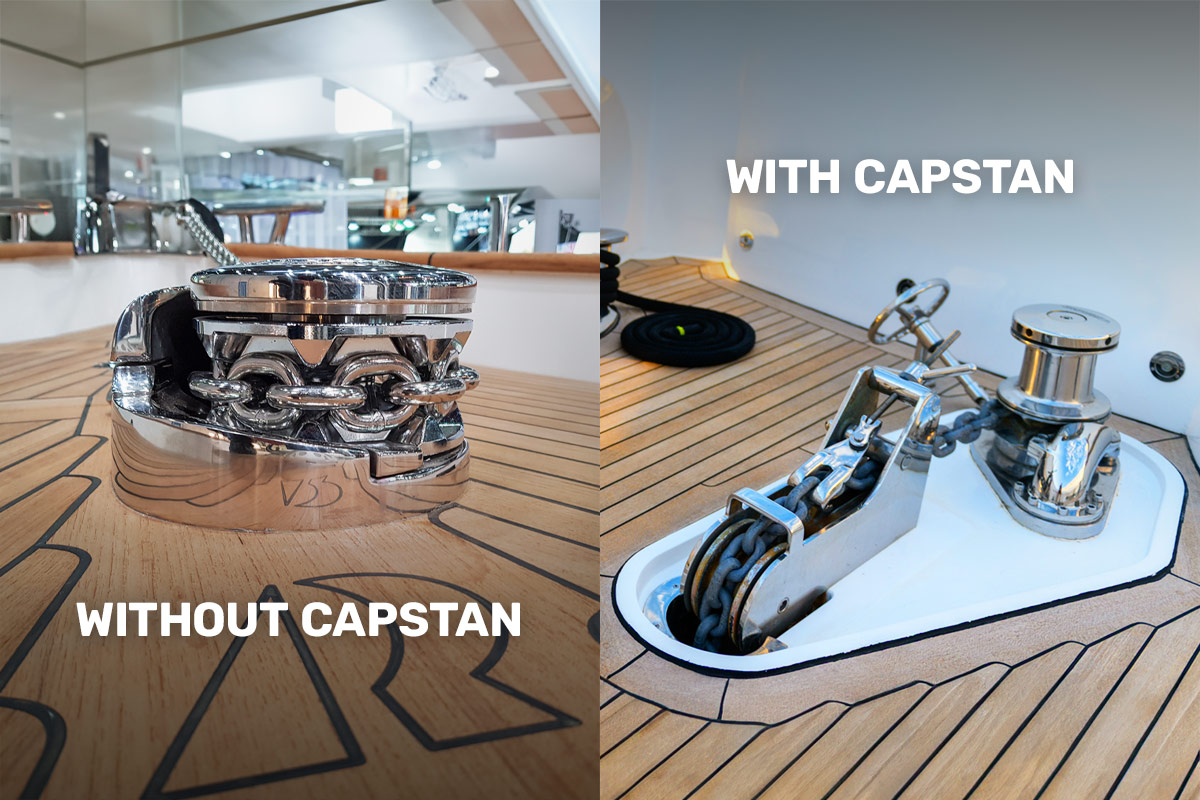
Every windlass is built around the gypsy, the notched wheel that grips the anchor rode and controls deployment and retrieval. Some models also include a capstan, which gives you a smooth drum for handling dock lines or taking controlled wraps on rope.
Motor orientation is also a key design difference between windlass styles. Vertical windlasses place the motor and gearbox below deck, while horizontal windlasses keep the motor and gypsy above deck on the same plane.
These design choices affect how the rode feeds, how much space the system needs, and how easy it is to install and service. Understanding the basics helps you avoid alignment problems, poor rode handling, and unnecessary wear once the windlass is in use.
Vertical Windlasses: Pros & Cons
Vertical windlasses offer the most natural rode alignment, with the chain or rope dropping straight down into the anchor locker. This straight feed reduces twisting, binding, and piling, especially on boats that use heavier chain.
Because the gypsy sits directly over the locker, vertical windlasses typically allow faster, smoother deployment and retrieval. Gravity helps the rode fall cleanly, which improves control and reduces strain on the motor during operation.
The main tradeoff is space below deck. Vertical windlasses require a deeper anchor locker and adequate clearance for the motor and gearbox, which can limit compatibility on boats with shallow or compact forepeaks.
Horizontal Windlass: Pros & Cons
Horizontal windlasses are often easier to install, especially on boats with limited locker depth. With the motor and gearbox mounted above deck, they avoid the need for significant below-deck clearance.
They work well with shallower anchor lockers and are commonly used on powerboats where space below the bow is tight. This makes them a practical option for retrofits or boats with constrained foredeck layouts.
The downside is increased exposure. With more components above deck, horizontal windlasses are more exposed to weather, spray, and foot traffic, which can affect long-term wear if not properly protected and maintained.
Which Style Fits Your Bow Layout?
Choosing between a horizontal and vertical windlass often depends on your bow layout. Anchor locker depth, rode path, and bow roller position all influence how cleanly the system feeds and how well it performs under load. Matching the windlass style to your boat’s physical layout helps avoid installation compromises and long-term handling issues.
Sailboats: Anchor Locker Geometry, and Bow Rollers
Many sailboats in the 25-45 ft range have deeper anchor lockers and narrower foredecks. This layout often favors a vertical windlass, allowing the rode to drop straight into the locker without interference.
Bow rollers on sailboats are typically aligned close to the centerline, which helps maintain a clean lead into the gypsy. Proper alignment reduces side loading and keeps chain and rope feeding smoothly under sail or at anchor.
That said, not all sailboats offer extensive space below deck. Older designs or boats with shallow forepeaks may still be better served by a horizontal windlass if clearance or access is limited.
Powerboats:Center Consoles, Cruisers, and Trawlers
Many powerboats have shallower anchor lockers and more complex bow structures. In these layouts, horizontal windlasses are typically easier to install without cutting or reworking the locker below.
Center consoles and express cruisers benefit from the simpler installation and reduced below-deck footprint of a horizontal windlass. That makes them a practical choice for both new installs and retrofits.
Trawlers and larger cruisers, however, may provide the depth and space required for a vertical windlass. In those setups, improved rode management and cleaner feed often make the vertical design a stronger long-term solution.
How to Size a Windlass for a 25-45 ft Boat
Proper windlass sizing starts with understanding your specific boat, not just its length. Displacement, hull shape, anchor and rode weight, and even the make and model of your boat all affect the loads the windlass must handle. Getting the size right therefore ensures reliable performance, protects your electrical system, and sets the foundation for safe anchoring in a wide range of conditions.
Understanding Working Load Limit (WLL) & Maximum Pull
When sizing a windlass, Working Load Limit (WLL) matters more than any headline spec. WLL reflects the continuous load the windlass is designed to handle during normal anchoring, which is where most real-world strain occurs.
Maximum pull, on the other hand, describes short bursts of force, such as breaking an anchor free. While it’s a useful measure, it doesn’t tell you how the windlass will behave during steady retrieval in wind, current, or swell.
For boats in the 25–45 ft range, focusing on WLL leads to more predictable performance. It also keeps the motor, gearbox, and mounting hardware working comfortably within their limits over time.
Chain & Rode Weight Calculations
Beyond the anchor itself, the windlass must lift the weight of the rode hanging between the boat and the bottom. As anchoring depth increases, that suspended weight adds up quickly.
This becomes even more important with all-chain rodes, which place constant load on the windlass before the anchor ever leaves the seabed. In deeper anchorages, the rode can account for a large share of the total retrieval load.
Taking total rode weight into account helps prevent undersizing. As a result, the windlass maintains steady speed and control instead of slowing, overheating, or stalling under load.
Anchor Weight Recommendations by Boat Size
As boats get larger, anchor size and weight naturally increase to maintain holding power. The windlass needs enough capacity to lift that anchor smoothly, even when it’s buried or loaded with bottom material.
Heavier anchors improve security, but they also raise retrieval loads. If the windlass is marginally sized, those extra pounds show up quickly when conditions aren’t ideal.
Matching anchor weight to windlass capacity keeps the system balanced. In turn, retrieval stays controlled and wear on the windlass is kept to a minimum.
Electrical Requirements: Breakers, Wire Gauge, and Run Length
Even a properly sized windlass won’t perform well without adequate power behind it. Windlasses draw significant current while under load, so breakers and wiring must be sized accordingly.
Voltage drop becomes a common issue on boats with long runs from battery to bow. Undersized cable reduces available power, which leads to slow operation and unnecessary strain on the motor.
Looking at your electrical layout early helps avoid these problems. This step is especially important on sailboats and larger cruisers where cable runs are longer and access is tighter. (Link to Defender wiring tips guide)
Sizing Table: Boat Length → Recommended Pull Power
Boat length provides a starting range, but final sizing should be adjusted for displacement, anchor weight, rode type, and anchoring depth. When in doubt, sizing slightly up improves reliability and reduces long-term strain on the windlass and electrical system.
| Boat Length | Typical Displacement | Recommended Working Load (Pull) | Common Rode Setup | Defender Recommended Models | Style |
| 25–30 ft | Light–Moderate | 700–1,000 lbs (320–450 kg) | Rope/chain combo |
Lewmar V700 Lewmar Pro-Fish 700 Lofrans Project 500 |
Vertical / Horizontal |
| 30–35 ft | Moderate | 1,000–1,500 lbs (450–680 kg) | Rope/chain or light all-chain |
Lewmar V2 Maxwell RC8-8 Muir Storm VRC 1250 |
Vertical |
| 35–40 ft | Moderate–Heavy | 1,500–2,000 lbs (680–900 kg) | All-chain preferred |
Maxwell RC10 Lofrans X2 |
Vertical |
| 40–45 ft | Heavy | 2,000–2,500+ lbs (900–1,135+ kg) | All-chain |
Lewmar V3 Maxwell RC12-10 Lofrans X3 |
Vertical |
Rode Selection: Chain, Rope, or Combination?
Before finalizing your windlass setup, start by choosing a rode that matches both your boat and how you anchor. Each option, whether it’s chain, rope, or a combination, changes holding power, retrieval load, locker space, and windlass performance under tension. For that reason, rode selection directly affects system load, gypsy compatibility, and how reliably the entire anchoring system works in real conditions.
Rope/Chain Combo for Cruisers and Sailboats
A rope/chain combination is the most common rode setup for cruising sailboats and mid-size powerboats. That’s because it offers a practical balance, delivering solid holding power and shock absorption while keeping overall weight and system load manageable.
At the anchor, chain provides abrasion resistance and dependable bite, while farther up the rope reduces weight forward. Together, this mix lowers strain on the windlass and, as a result, makes retrieval easier on boats that anchor frequently.
For boats in the 25-45 ft range, rope/chain setups also pair well with shallower anchor lockers. By relying on rope for most of the length, they allow adequate scope without filling the locker with heavy chain.
Gypsy Compatibility: ISO G4 vs BBB vs Proof Coil
Gypsy compatibility is one of the most critical details in a windlass system. Crucially, chain types that look similar on paper can behave very differently once they’re under load.
ISO G4 chain has become the most common standard on cruising boats, while BBB and proof coil chains use different link dimensions. Even when the nominal size appears correct, those differences affect how the chain seats and grips in the gypsy.
When the chain and gypsy don’t match, problems show up quickly during retrieval. In these cases, skipping, binding, and accelerated wear increase system load and shorten the lifespan of both the gypsy and the rode.
Ideal Rode Length for Boats 25-45 ft
Rode length plays a direct role in how well an anchor holds as conditions change. For boats in the 25-45 ft range, having enough rode to maintain proper scope is just as important as anchor size.
In deeper water, longer rodes allow the pull on the anchor to stay low and consistent. Shorter rodes, by comparison, create steeper angles that increase strain on the anchor, rode, and windlass.
At the same time, rode length has to fit the physical limits of the boat. The key considerations for this are locker space and fall distance, which determine how cleanly the rode deploys, stacks, and retrieves under load.
Regional Considerations
- Florida: Sandy bottoms and frequent anchoring favor rope/chain combinations with moderate chain length. Warm water, salt exposure, and high use rates make chain quality and proper gypsy compatibility especially important in Florida.
- Northeast: Mud bottoms create strong suction loads that increase strain during retrieval. Longer rodes and heavier chain also help maintain holding through tidal swings and changing conditions.
- Great Lakes: Mixed bottoms and variable depths reward flexibility over maximum chain weight. Rope/chain combinations work well for adapting to different anchoring conditions throughout the season.
- Pacific Northwest: Deep anchorages, strong currents, and kelp place sustained load on the anchoring system. Longer rodes and higher chain percentages are commonly used to keep retrieval controlled and predictable.
Key Features to Compare in Modern Windlasses
Once you’ve narrowed down size and rode type, the next step is comparing the features that affect how a windlass performs day to day. Motor and gearbox design, recovery options, controls, and long-term durability all shape how smoothly the system operates and how well it holds up under repeated load. Viewed as a system, these features quickly show what improves real-world anchoring and what’s just noise.
Motor Power & Gearbox Durability
Motor power determines how confidently a windlass can lift anchor and rode under load. Just as important, the gearbox has to translate that power smoothly without slipping, binding, or overheating.
Higher-quality windlasses use robust gear trains designed for sustained loads, not just peak pull numbers. That difference shows up during difficult retrievals, when the anchor is buried or the boat is loading the rode with wind and current.
Over time, a well-matched motor and durable gearbox reduce wear across the entire anchoring system. The result is steadier performance, quieter operation, and fewer issues when anchoring demands increase.
Manual Recovery Options
Even on electric windlasses, manual recovery is an important backup feature. If power is lost or the motor fails, the ability to retrieve the anchor by hand can be the difference between an inconvenience and a serious problem.
Some windlasses use a standard winch handle for manual recovery in a process many boat owners will be familiar with. Others rely on dedicated tools supplied by the manufacturer, and might also involve partial disassembly of the system.
What matters most is how the system is laid out on the boat. Manual recovery is most practical when the required tools are stored nearby, access is clear, and the process is familiar before it’s needed under load.
Waterproofing & Corrosion Resistance
Windlasses live in one of the harshest environments on the boat, where salt spray, washdowns, and standing water are routine. As a result, how well a unit is sealed and protected has a direct impact on how reliably it works over time.
When water finds its way into electrical or mechanical components, problems tend to follow quickly. That’s why quality windlasses rely on sealed motors, protected gearboxes, and corrosion-resistant materials to limit water intrusion and exposure.
And corrosion resistance matters just as much above as below deck. Over time, stainless hardware, properly coated housings, and sealed fasteners hold up better, especially on boats that anchor often or live in saltwater.
Free-Fall vs Power-Down Models
Free-fall windlasses release the anchor by gravity once the clutch is disengaged. This allows the anchor and rode to deploy quickly, which can be useful when precise positioning matters.
Power-down models use the motor to control deployment as well as retrieval. That controlled feed reduces the chance of overruns, chain piling, or sudden shock loads on the system.
The right choice depends on how you anchor and the conditions you expect to handle. Free-fall favors speed and simplicity, while power-down prioritizes control and consistency, especially in tighter anchorages or rougher water.
Foot Switches vs Remote vs Helm Controls
Foot switches are the most direct way to control a windlass from the bow. They give immediate feedback while you’re watching the anchor and rode, making it easier to manage deployment and retrieval under load.
Remotes, meanwhile, add flexibility by letting you control the windlass from a safer or more convenient position. This can be useful when short-handed or when you need to manage the boat while keeping an eye on the anchor.
Helm controls, on the other hand, move windlass operation away from the foredeck altogether. While convenient in some setups, they work best when paired with good visibility or clear communication, since anchoring benefits from seeing what the gear is doing in real time.
Serviceability, Spare Parts, and Brand Support
Even a well-built windlass will need attention over time, whether from normal wear or an unexpected issue. In day-to-day use, serviceability matters just as much as initial build quality.
Some windlasses are designed with maintenance in mind, using modular components and common wear parts that are easy to access. Others require deeper disassembly or rely on proprietary parts, which can turn a simple fix into a bigger job.
Over the long run, brand support also becomes a major part of the equation. When parts are readily available and documentation is clear, keeping a windlass working is usually straightforward; when they aren’t, owners may end up replacing entire units sooner than expected.
Brand Comparison: Best Windlasses for Boats 25–45 ft
Once sizing and key features are set, choosing a windlass comes down to how different manufacturers’ windlasses hold up to real-world use. Motor design, gearing, controls, and long-term support vary by brand, and those differences tend to show up after a few seasons on the water. With that in mind, compare the major brands side by side to find a windlass that fits your boat type, anchoring habits, and long-term expectations.
Lewmar
Lewmar is one of the most widely used windlass brands on production sailboats and powerboats. Their designs emphasize broad compatibility, straightforward installation, and easy access to parts and service.
The Pro-Fish series is popular on smaller cruising boats and fishing-focused setups, especially where compact size and free-fall capability matter. The V-Series, meanwhile, is a common choice on cruising sailboats and express cruisers that need reliable performance with rope/chain or all-chain rodes.
Lewmar windlasses tend to fit well on boats with limited bow space or standard production layouts. They’re therefore a solid option for coastal cruisers who want proven designs with widespread dealer support.
Lofrans
Lofrans windlasses are built around mechanical strength and long-term reliability rather than compact size or added features. Their designs favor solid gear trains, durable components, and straightforward operation.
Many Lofrans models place a strong emphasis on dependable manual recovery and simple mechanical layouts. As a result, they’re often chosen by cruisers who want systems that remain usable even when power is limited or conditions are less forgiving.
Lofrans windlasses are commonly found on cruising sailboats used for extended trips or liveaboard use. They’re a familiar choice among owners who anchor regularly and prioritize durability and backup capability over convenience features.
Maxwell
Maxwell windlasses are built with an emphasis on strength, load handling, and long-term durability. Their designs rely on heavy-duty materials and robust gear trains intended to hold up under sustained strain.
Corrosion resistance is central to that approach, with finishes and components selected to perform in harsh marine environments. This makes Maxwell windlasses a common choice on boats that anchor in exposed conditions or deal with higher sustained loads.
You’ll most often see Maxwell units installed on larger cruising sailboats, trawlers, and expedition-style vessels. As a result, they’re a strong fit for owners who value mechanical strength and consistent performance under load more than compact sizing or lighter-duty construction.
Muir
Muir windlasses are built with a strong focus on durability, load handling, and long-term reliability in demanding anchoring conditions. Their designs favor robust construction and conservative engineering, making them well suited for boats that anchor frequently or carry heavier ground tackle.
You’ll see this approach in Muir’s motor sizing, gear trains, and all-metal construction, which prioritize pulling power and longevity over compactness. The result is a smooth, controlled operation that holds up under repeated high-load cycles without excessive wear.
Muir windlasses are commonly found on cruising sailboats, trawlers, and serious offshore powerboats in the mid-size range. They’re a solid choice for owners who value proven performance and mechanical strength, especially when anchoring regularly in wind, current, or deeper water.
Side-by-Side Specs Table: Windlasses for Boats 25-45 ft
Use this comparison to narrow brands based on load capacity, space constraints, and chain compatibility, then select a specific model sized for your boat’s displacement and anchoring habits. Published specs vary by model, so final selection should always confirm gypsy compatibility, electrical requirements, and locker fit.
| Brand | Typical Max Pull | Retrieval Speed | Motor Wattage | Unit Weight | Gypsy Options | Chain Size | Suitable Boat Length |
| Lewmar | ~700–2,000 lbs | Moderate to fast | ~700–1,500 W | Light–Moderate | Rope/chain, chain-only | 1/4", 5/16", 8 mm | 25–45 ft |
| Lofrans | ~1,000–2,200 lbs | Moderate | ~1,000–1,700 W | Moderate–Heavy | Chain-only, rope/chain | 5/16", 8 mm, 10 mm | 30–45 ft |
| Maxwell | ~1,200–2,500+ lbs | Moderate | ~1,200–2,000+ W | Heavy | Chain-only, rope/chain | 5/16", 3/8", 10 mm | 30–45+ ft |
| Muir | ~1,200–2,500+ lbs | Moderate | ~1,200–2,000+ W | Heavy | Chain-only, rope/chain | 5/16", 3/8", 10 mm | 30–45+ ft |
How to Ensure a Proper Windlass Installation
Even the right windlass will underperform if it isn’t installed correctly. Alignment, deck structure, and electrical layout all play a direct role in how smoothly the rode runs, how much load the system can handle, and how reliable it is over time. Paying attention to these details during windlass installation helps avoid common problems and ensures the windlass works properly when it’s actually doing the work.
Bow Roller Alignment & Rode Flow
Bow roller alignment sets the tone for how the entire anchoring system behaves. From the start, if the rode doesn’t lead cleanly from the roller into the windlass, problems show up quickly during deployment and retrieval.
The rode should approach the gypsy on a straight, unobstructed path. Side loading and sharp angles increase friction, encourage chain stacking, and accelerate wear on both the rode and the windlass.
Alignment also affects how the rode falls into the anchor locker. When the lead is correct, the rode feeds smoothly and stows evenly; when it isn’t, piling and binding become ongoing issues that show up whenever the anchor is raised.
Deck Reinforcement Requirements
A windlass concentrates a lot of load into a small area of the foredeck. Without proper reinforcement, this pressure transfers directly into the deck skin and core, where damage can develop over time.
As a result, the mounting surface needs to be solid enough to spread load beyond the windlass footprint. This usually means backing plates, solid laminate, or properly reinforced core rather than relying on the deck alone.
And, reinforcement matters just as much below deck as it does on top. A stiff, well-supported mounting area keeps fasteners tight, prevents flexing, and helps the windlass stay aligned as loads increase.
Wiring Runs and Breaker Placement
A windlass draws more current than most onboard accessories. Consequently, wiring size, run length, and breaker placement have a direct impact on how well it performs under load.
Long cable runs from the battery to the bow introduce voltage drop if they aren’t sized correctly. When that happens, the windlass may run slowly, trip breakers, or struggle during retrieval.
Just as important is where the breaker is installed. Properly sized breakers placed close to the power source protect the system and make troubleshooting easier when something goes wrong.
Avoiding Common Installation Failures
Most windlass issues don’t come from the unit itself but from how it’s installed. Problems like chain stacking, poor rode flow, or misalignment, for example, usually show up quickly and tend to get worse the more the system is used.
Electrical shortcuts are another frequent source of trouble. Undersized wiring, long runs, or poorly placed breakers lead to voltage drop and inconsistent performance, which is why reviewing Defender’s wiring tips guide before installation is time well spent.
Structural failures are less obvious but often more expensive to fix. For instance, inadequate deck reinforcement or weak core support allow flex under load and gradually loosen hardware, problems that proper planning and reference to the windlass selection guide can prevent from the start.
Checklist: Choosing the Right Windlass for Your Boat
There’s a lot to consider when choosing the right windlass for your boat, but this checklist will help you keep in mind the most important things to consider before you buy:
- Boat length & displacement: Length is a starting point, but displacement drives real anchoring loads.
- Anchor type & rode: Anchor weight, chain size, and rope or chain combinations must match the gypsy and pull rating.
- Locker depth: Adequate fall distance is critical for clean rode stacking and reliable retrieval.
- Bow geometry: Bow roller position and lead angle affect rode flow into the windlass.
- Chain locker layout: Space, access, and drainage all influence long-term reliability.
- Installation scope (DIY vs. professional): Some installs are straightforward; others require structural or electrical work best handled by a pro.
- Electrical system capacity: Battery size, cable runs, and breaker placement must support high current draw under load.
Defender’s Suggested Windlasses for Boats 25–45 ft
After comparing designs, features, and installation requirements, the final step is narrowing the field to models that consistently perform well on boats in this size range. These suggestions focus on proven reliability, realistic load handling, and compatibility with common bow layouts rather than headline specs alone. Discover the ideal windlass for your boat layout, anchoring style, and the conditions you anchor in most often.
Best Overall
For most boats in the 25-45 ft range, the Lewmar V-Series and Maxwell RC Series represent the best all-around balance of power, durability, and installation flexibility. Both lines are well proven across sailboats and powerboats with common anchor and rode setups.
These windlasses handle rope/chain and all-chain rodes cleanly, offer realistic pulling power for mid-size boats, and are supported by widely available parts and service. In practice, they’re dependable choices for owners who want consistent performance without tailoring the system to a narrow use case.
If you’re looking for a windlass that works across a broad range of layouts and anchoring habits, these models are a strong place to start. They’re frequently chosen by Defender customers as reliable, do-it-all solutions.
Best for Sailboats
Sailboats benefit from windlasses that manage straight rode flow and work well with deeper lockers. In this respect, the Lewmar V-Series and Lofrans Tigres are both well suited to typical cruising sailboat layouts in this size range.
These models handle rope/chain combinations smoothly and maintain consistent retrieval even when the boat is moving under sail. Vertical configurations, in particular, pair well with narrow foredecks and centerline bow rollers.
For cruising sailboats that anchor frequently, these windlasses offer predictable rode handling and long-term reliability. That’s why they’re commonly selected for boats where clean alignment matters as much as raw pulling power.
Best for Powerboats
Powerboats often require compact windlasses that install cleanly on shallower lockers and more complex bows. The Lewmar Pro-Fish series and Muir models are well matched to those constraints.
These windlasses offer controlled deployment, practical pulling power, and simpler installation on center consoles and express cruisers. Their smaller footprints make them easier to retrofit without major structural changes.
For powerboat owners who want reliable anchoring without reworking the bow, these models strike a practical balance. They’re popular choices for boats that anchor often and reset frequently throughout the day.
Best for Offshore Use
Anchoring in exposed conditions places sustained load on the entire system. For that role, the Maxwell RC Series and heavier-duty Lofrans Project models stand out for their mechanical strength and corrosion resistance.
These windlasses are built to manage heavier anchors, longer rodes, and higher retrieval loads without overheating or flexing. Their designs favor durability and consistent performance over compact sizing.
For cruisers who anchor outside protected harbors or in changing conditions, these models provide a greater margin of confidence. They’re often chosen by owners who prioritize strength and reliability over weight savings.
Best Budget Windlass
For lighter boats in the 25–45 ft range with moderate anchoring demands, budget-focused models can still perform well when matched correctly. The Lewmar Pro-Fish series and select Muir models offer solid functionality without higher-end features.
These windlasses meet proper load requirements for smaller anchors and shorter rodes, while keeping cost and complexity in check. They work best when the anchoring system is sized conservatively and installed carefully.
For owners adding powered anchoring for the first time, these options provide good value without overbuilding the system. They’re a practical entry point within Defender’s more affordable windlass offerings.
FAQs: Windlasses for Boats 25-45 ft
Boat length is only a starting point, since displacement, anchor weight, chain size, and anchoring depth drive real load. Taking all these factors together, two boats of the same length can require very different pull ratings depending on how they’re equipped.
Most boats in this range land in mid-size windlasses like the Lewmar V-Series or Maxwell RC Series when matched correctly. Bear in mind that sizing for the heavier setup keeps the windlass working comfortably instead of right at its limit.
The right choice depends on bow layout, not preference, with locker depth and rode lead angle mattering most. Simply put, orientation alone doesn’t determine performance if the lead isn’t clean.
Vertical windlasses suit deeper lockers, while horizontal models are often easier to fit on shallower or tighter layouts. Matching the style to the boat avoids rode-handling issues that show up later.
All-rope rodes are rarely a good match for windlasses on boats this size, since most gypsies are designed for chain or rope/chain combinations. As a result, rope alone tends to slip or wear prematurely during retrieval.
A rope/chain setup provides better grip, abrasion resistance, and more predictable handling. It also keeps overall system load more manageable on boats from 25-45 ft.
Often yes, since a windlass depends on clean alignment between the bow roller, rode, and gypsy. Many older rollers weren’t designed for powered retrieval, and you’ll need a newer design that can fit seamlessly into your system.
If the roller doesn’t center or support the rode properly, binding and uneven wear tend to follow. Addressing alignment during installation therefore prevents problems that are difficult to fix later.
Coastal anchoring usually works well with a moderate length of chain followed by rope to balance holding and weight. This setup covers most day anchoring and overnight stops.
In deeper or more exposed anchorages, longer chain lengths are common, as long as the windlass and locker can handle it cleanly. The key for a safe anchorage is to stay within what the windlass and locker can handle cleanly.
Windlasses draw high current, so wiring size, breaker rating, and run length must be evaluated carefully. It’s especially important to address any undersized cable or poor breaker placement, as these lead to voltage drop and weak performance.
Battery capacity and charging capability also matter, especially on boats with long runs to the bow. Reviewing Defender’s wiring tips guide helps prevent voltage drop and performance problems.
Yes, but older boats usually require checking deck structure, core condition, and existing wiring first. These factors determine the size and style of windlass that can be installed safely.
Compact, retrofit-friendly options like the Lewmar Pro-Fish or select Quick windlasses are often easier to fit. Along with your new windlass, remember that in many cases you’ll also need to reinforce the foredeck and upgrade your electrics.