 Shopping from Canada?
  Go to Defender Canada!



Best AIS Systems for Recreational Boats: Complete Buyer’s Guide
AIS used to be equipment you’d mostly find on commercial ships or offshore passagemakers. But today, it’s almost as common on recreational boats as it is on larger commercial vessels. With more traffic on coastal waters, busy harbors, and inland shipping routes, knowing who’s around you (and making sure they can see you) is an important part of safe boating.
| Feature | Class A AIS | Class B AIS |
| Typical user | Commercial ships and workboats | Recreational boats |
| Transmission power | Higher | Lower |
| Reporting interval | More frequent | Less frequent |
| Data transmission | More robust vessel reporting | Recreational-level reporting |
| Installation and cost | More complex and expensive | Simpler and more attainable |
| Best fit | Required commercial applications | Coastal cruising, sailing, offshore recreation |
| Network Standard | What It Means for Your Setup | Best Fit |
| NMEA 0183 | Older point-to-point wiring that can take more manual setup | Boats with existing legacy electronics |
| NMEA 2000 | Newer plug-and-play network that simplifies integration | Boats with modern, networked electronics |
| Boating Style | Why AIS Matters | Recommended System | Key Feature Priorities |
| Sailboats | Sailboats often maintain steady courses under sail and may operate offshore or in fog, making visibility to other vessels critical. | Class B AIS Transponder | Strong GPS performance; masthead or well-positioned antenna; chartplotter integration; reliable offshore target visibility |
| Offshore Fishing Boats | Offshore runs involve speed, changing weather, and busy helm stations where quick awareness of surrounding traffic is essential. | Class B AIS Transponder | Strong MFD integration; radar compatibility; dependable GPS input; system redundancy for offshore operation |
| Great Lakes Cruising | Recreational boats frequently share water with large commercial freighters, where early traffic awareness is important for safe navigation. | Class B AIS Transponder | Reliable position updates; commercial traffic awareness; CPA/TCPA display integration; simple, dependable operation |
| ICW & Coastal Cruising | Busy waterways with ferries, bridges, and tight channels benefit from clear vessel tracking and traffic awareness. | AIS Receiver or Class B Transponder | Easy electronics integration; antenna splitter compatibility; clear target display; simple day-to-day operation |
| Step | What You’re Doing | What Matters | Common Watch-Out |
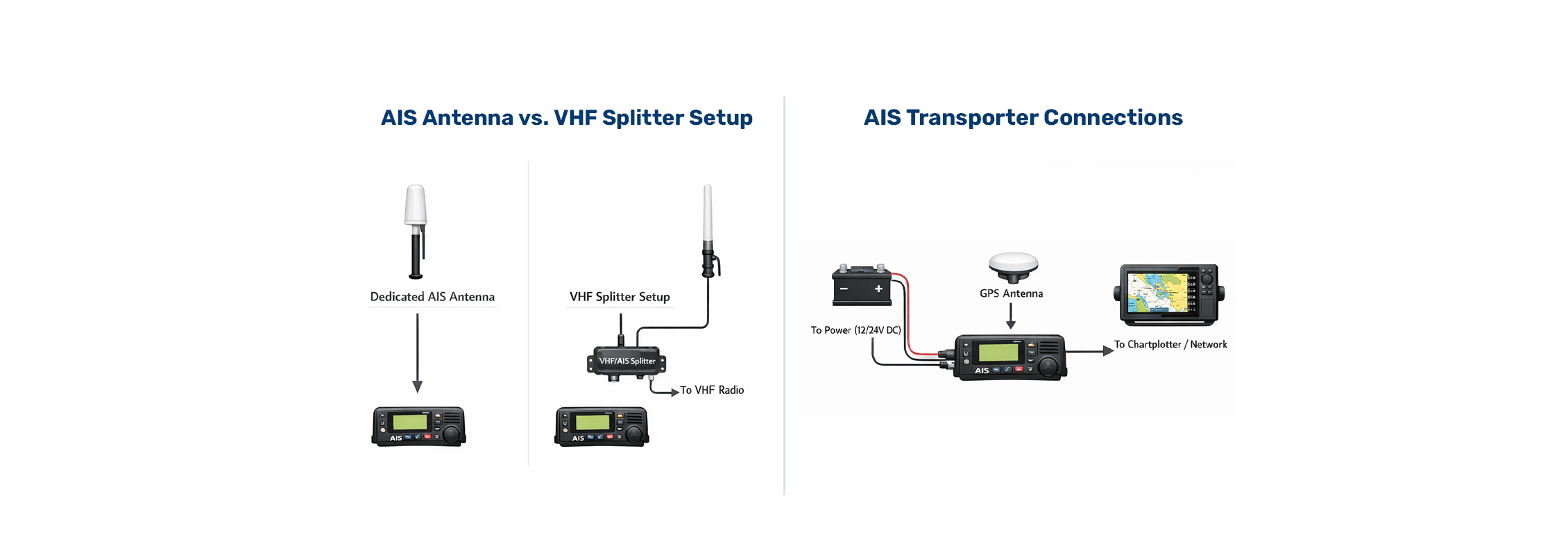
| 1. Choose antenna setup | Decide between a dedicated AIS antenna or a VHF splitter | Antenna height, clean signal path, compatible hardware | Cheap splitter shortcuts and poor antenna placement |
| 2. Power connection | Supply clean, fused DC power to the unit | Correct fuse size, solid connections, proper wire routing | Sloppy wiring and overloaded circuits |
| 3. Connect to chartplotter | Link the transponder to a compatible display via NMEA 0183 or NMEA 2000 | Confirm display compatibility and network setup | Assuming the chartplotter will display AIS without proper setup |
| 4. Enter MMSI and static data | Program vessel details into the unit | Accurate MMSI, vessel info, and setup data | Entering bad data or rushing through setup |
| 5. Testing and verification | Confirm the unit powers up, gets a fix, and is transmitting/receiving correctly | GPS lock, target display, alarm status, transmission check | Treating “powered on” like the same thing as “working properly” |