 Shopping from Canada?
  Go to Defender Canada!



Description
The Airmar DST810 Smart Multisensor delivers fast, accurate speed, depth, and attitude data in a single NMEA 2000® device. With 5 Hz speed output, wireless calibration via the CAST™ App, and heel/trim compensation, it's an ideal sensor for both sailing and powerboats.
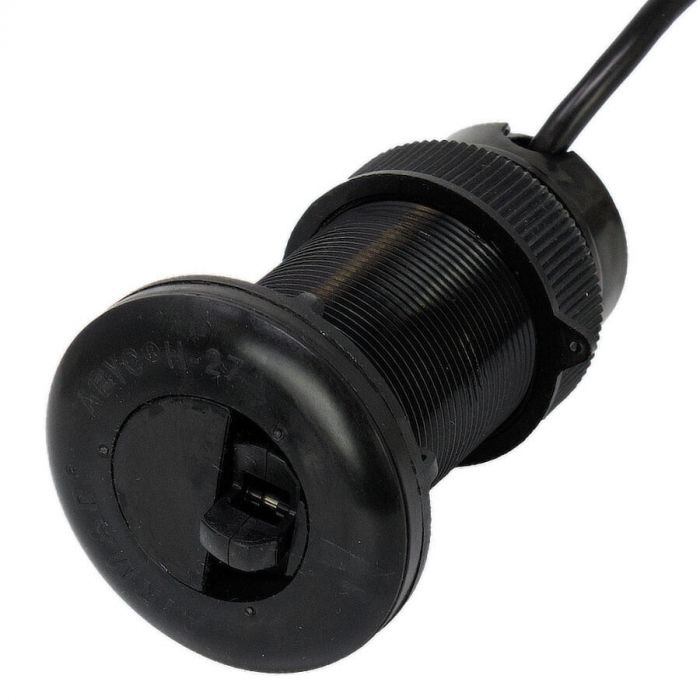
Airmar DST810 Smart Multisensor Item # 859952
Description
The DST810 Smart Multisensor, together with Airmar's CAST™ App, is the convergence of advanced hull data, matched with a simple and reliable way to calibrate accurate speed via a wireless device.
Features:
- 5 Hz speed output (5X per second) for visibly smoother speed-through-water reporting and faster data for better decision making
- Integrated attitude sensor for heel and trim benefits sailing and power boats
- Simple attitude calibration to correct for off-center mounting
- Wireless connectivity to Airmar's CAST App has new user-friendly benefits:
- Calibrate the DST810 in a simple, intuitive way regardless of the instrument brand or model that is on board
- Conduct basic and advanced heel-compensated speed calibrations for improved speed-through-water outputs across the speed range
- Advanced Speed Calibration allows for manual speed entries for multiple heel angles and up to 10 speeds, formerly only possible through expensive PC software
- Enable and disable PGN's and set offset and output rates
- The Perfect Sensor for Sailing:
- New 5 Hz speed output for visibly smoother speed data
- Incredibly easy calibration via Airmar's CAST App. Wirelessly connect, calibrate speed, and configure data
- DST810 stores configurations and delivers data to the NMEA 2000® network
- Depth, heel-corrected speed-through-water, heel and trim, and water temperature from one installed multisensor
- The Perfect Sensor for Powerboats:
- 5 Hz speed, depth, pitch and roll, and water temperature from one installed instrument
- Simple depth offsets and corrected speed-through-water via Airmar's CAST™ App
- Popular depth sensor for shallow water performance
Specifications:
- Weight:
- Plastic: 0.9 kg (2.0 lbs)
- Bronze: 1.6 kg (3.5 lbs)
- Stainless Steel: 1.9 kg (4.2 lbs)
- Acoustic Window: Urethane
- Hull Deadrise: Up to 22°
- Data Update Rate:
- Depth: 1X/ second
- Speed: 5X/ second
- Heel/Trim: 10X/ second
- Attitude Accuracy: +/ -1° nominal after sensor calibration
- Depth Frequency: 235 kHz
- Minimum Depth Range: 0.5 m (1.6')
- Maximum Depth Range: Up to 100 m (330') -- NMEA 2000®
- Speed Range: Up to 45 knots
- Pressure Rating: 3 m (10')
- Pulse Rate: 20,000 p/nm (5.6 Hz per knot) p/nm (pulses per nautical mile)
- Supply Voltage: 9 VDC to 16 VDC -- per NMEA 2000
- Supply Current: <200 mA -- per NMEA 2000®
- Wireless Protocol: Bluetooth Low Energy (BLE)
- Wireless Range: Up to 30' depending on mount location
- Standard Cable Length: 6 m (20') DeviceNet -- NMEA 2000®
- Temperature Sensor Accuracy: ±0.5°C (±1.8°F)
- Temperature Sensor Range: -10°C to 40°C (14°F to 104°F)
- NMEA 2000 Load Equivalency Number (LEN): 3
- CE Regulation: Complies to IERC60945
Note: Smartphone not included.
Airmar DST810 Smart™ Multisensor Product Data Sheet (2.72 MB)
Part Numbers for Airmar DST810 Smart Multisensor
Reviews
Rated 1 out of
5
by
gvansickle from
plastic hub check valve is flimsy
Can't comment on the sensor yet as we are not in the water yet. The NMEA cable was just barely long enough to reach our backbone tie-in. More importantly, after installing the plastic thru hull hub, the check valve broke on the initial test fit of the transducer. It is held in place by a tiny tiny pin and a flimsy flap of plastic. Poor design. Airmar did send a replacement, but would not buy again.
Date published: 2026-01-26
Rated 2 out of
5
by
DanG from
Bad design
I have had one for four seasons. It replaced an analog Airmar model. Lots of annoyances. First, I made the mistake of assuming that this transducer would be a drop-in replacement for the old one. After all, a lot of them are going to replace an older model. Or at least some warning in the spec sheet or web page or wherever. Found out the day before launch that the new transducer did not fit the old housing. Fire drill with the boatyard to get the new one installed.
The new style impeller is supposed to be more accurate than the old one. Maybe. Until sea critters take residence in the open space between the bottoms of the blades and the shaft. To say nothing of getting between the impeller and the housing. Yeah, the old style got gunked up too. Just not as readily as the new style. And a lot easier to clean.
To accommodate the depth sensor, the impeller is offset to one side of the transducer. The outside, thinner part of the moulding is not stiff enough, and if it is bent in a bit, it binds on the impeller. That can easily happen when inserting the transducer in the housing. No warning about that in the instructions.
The shaft for the impeller is press fit through the thinner part of the transducer moulding into the thicker part. It is only exposed at the thinner side. It is slightly recessed to fit into the housing. To remove it, a very fine needle nose pliers has to be inserted into the recess to pul the shaft out. The recess is so shallow that getting a grip on it is extremely difficult. After numerous attempts, the end of the shaft rounds over, making it even more difficult to get out. At least with the old style, the shaft could be pushed out with a small punch.
The housing has a flap that is supposed to block most of the water flow when the transducer or blanking plug is removed. Works great,,, until it stops working. I have no Idea why it is not deploying, and won’t until the boat is hauled. In the meantime cleaning the transducer makes a huge mess.
All in all, a bad design.
Date published: 2025-08-15
Rated 5 out of
5
by
Capt JR from
Airmar Smart Speed depth sensor
Easy to use, just plug into the NMEA 2000 network and accessable to all devices
Date published: 2025-04-01
Rated 5 out of
5
by
Bob M from
DST 810 Transducer
Unit was shipped quickly and arrived in a timely manner.
Date published: 2025-01-01
Questions
Will this work with the raymarine axiom pro 9 chart plotter?
requires a NMEA2000 to SeaTalkNG adapter/cable to make the connection to a Raymarine backbone
Date published: 2024-04-29
Want to make sure this will work with my raymarine i70 display.
It worked with mine. Note that you need the version with the SeatalkNG connector. If you get the version with the NMEA2000 connector, you will need the NMEA2000 to SeatalkNG adapter from Raymarine.
Date published: 2026-07-06